
Bleak Forest
Tabletop RPG System
Created by Johnathan L Bingham
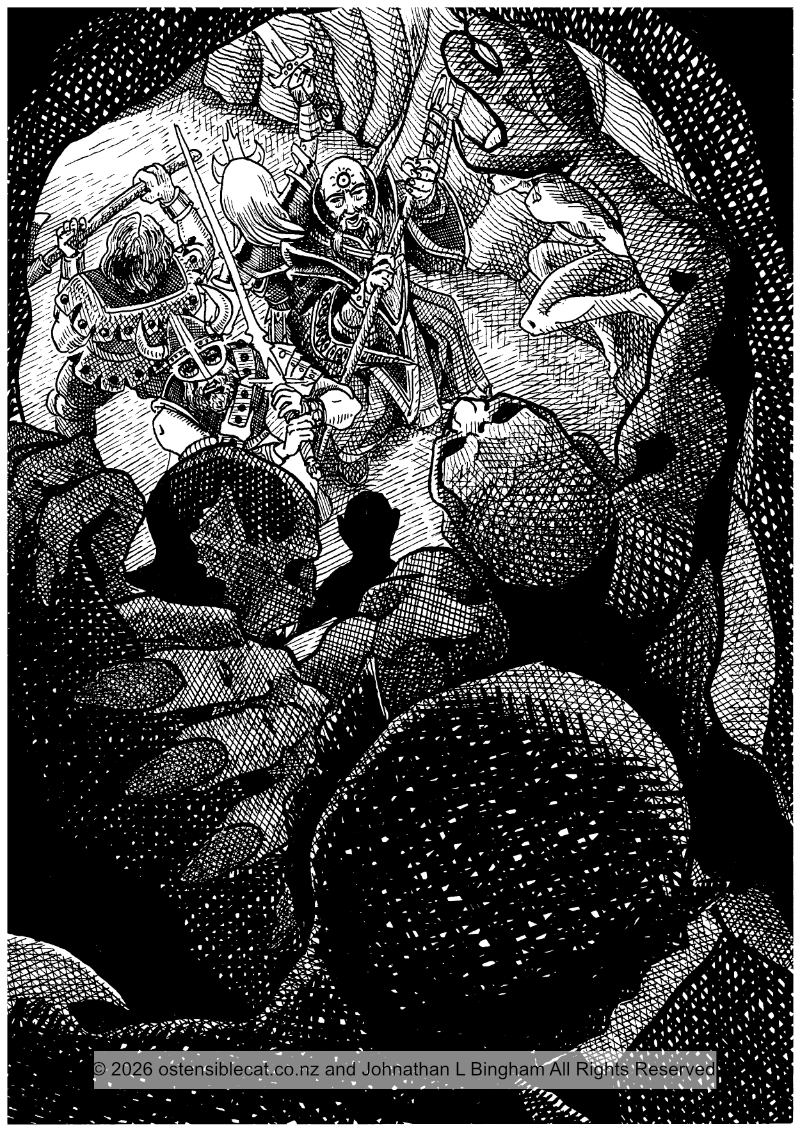
Challenges and Ordeals drive the game towards fulfilment of the cycle. Fragments make an event ready; an Omen says when it starts. This replaces the Challenge Track. Sisters’ Omens are simply Omens and follow the same rules as any other Omen.
Challenges are the personal trials at the heart of Escape the Bleak Forest. Presented by the Three Wyrd Sisters, they test Corpus, Anima, or Spiritus and determine who the Nameless becomes through Recursion. A Challenge is tied to an attribute because its reward Locks that attribute. It tests who the character is and what they will become.
A successful Challenge Locks the tested attribute and grants an Identity Mark. The Maiden offers a Vow or Knot after a Minor Challenge, the Matron offers a Vow or Scar after a Moderate Challenge, and the Crone offers a Scar or Knot after a Major Challenge. A Challenge therefore changes more than an attribute; it establishes a promise the character must uphold, a lasting wound they must carry, or a survival lesson they can call upon.
Ordeals carry that completed identity into Bleak Forest: Hail Three Wyrd Sisters. They are wider scenarios in which the character’s Vows, Scars, and Knots are tested against problems affecting a place, community, or region. Ordeals do not replace the character’s Identity Marks. They create situations in which a Vow’s constraint matters, a Scar complicates or illuminates action, and a Knot provides a learned response.
An Ordeal has an overall BAM! for its decisive resolution and is built from 2–4 tasks rolled against attributes, covering at least two different attributes. This ensures that every character has a way into the Ordeal and allows Identity Marks to matter at the task level. Completing an Ordeal changes the world, advances Degrees of the Road, and may also deepen, reinterpret, or add to the character’s Identity Marks when its outcome calls for it.
Both Challenges and Ordeals have Minor, Moderate, and Major tiers, but they operate at different scales. A Challenge is a test of becoming: Minor is Average (13), Moderate is Difficult (16), and Major is Challenging (19). An Ordeal is a problem in the world whose decisive resolution ranges from Difficult (16) to Formidable (22). Its encounters, discoveries, negotiations, and tasks build towards that resolution.
Throughout either event, apply the character’s Identity Marks whenever their triggers, benefits, or constraints are relevant.
- Vows: A Vow is a personal law with a benefit and a constraint. Its benefit applies when relevant, but the character must honour its constraint during a Challenge or Ordeal. If an event makes two Vows incompatible, choose which to honour and resolve the consequences of breaking the other under the rules of the game being played.
- Scars: A Scar is a permanent wound, burden, or hard-won insight. Apply its complication whenever the fiction invokes it. When a Scar gives the character special perspective, permission, or an applicable benefit, it may also open an approach that would otherwise be unavailable. A Scar is not removed by success, though its meaning may change.
- Knots: A Knot is a learned survival response with a specific trigger and limit. It may be used during a Challenge or during an appropriate task within an Ordeal. Using a Knot can change how a task is attempted, but it does not by itself complete the entire event unless that event explicitly says so.
Fragments, Preparation, and Omens
The cycle of a Challenge or Ordeal follows four steps:
- Find Fragments. Each Fragment is a clue tied to one named Challenge or Ordeal.
- Become Prepared. When the event holds the required number of Fragments, it becomes Prepared.
- Receive an Omen. The world signals that the Prepared event begins, usually establishing when or where it starts.
- Resolve the Event. Face the Challenge or Ordeal. Apply its rewards on success, or its Blight on refusal or failure.
Fragment
A Fragment is a piece of evidence tied to one named Challenge or Ordeal. Fragments may be gained through Explore, encounters, Rare Encounters, loot, Lore, or Echoes. Exploring for a Fragment requires a Wits check (Difficult 16) unless another rule specifies otherwise. Record each Fragment against its event. Fragments never transfer between Challenges or Ordeals. If a Fragment has been discovered but its associated event is unknown, a successful Lore check identifies which Challenge or Ordeal it belongs to.
Prepared
An event becomes Prepared when it holds its required number of Fragments.
| Tier | Challenge Fragments | Ordeal Tasks | Ordeal Fragments |
|---|---|---|---|
| Minor | 2 | 2 | 3 |
| Moderate | 3 | 3 | 4 |
| Major | 4 | 4 | 5 |
An Ordeal therefore always requires a number of Fragments equal to its number of tasks +1. One Fragment reveals each task, while the final Fragment reveals the underlying cause. A Prepared event does not begin immediately. It waits for an Omen.
Omen
An Omen is a sign that a Prepared Challenge or Ordeal begins. Omens may come from:
- Danger Die Special results
- Sisters’ Omens
- scenario triggers
- an event’s generated Omen
- the Omen timing roll
When an Omen occurs for an event that is Prepared, begin the event at the time and place indicated by the Omen.
If the event is not yet Prepared, the Omen does not begin it. Instead, it reveals the type of the event’s next missing Fragment.
Omen Timing
Once an event is Prepared, roll 1d6 at the end of each Watch. On a 6, its Omen arrives. Add +1 to the roll for each Watch already waited since the event became Prepared.
Danger Die Special results, Sisters’ Omens, and specific scenario triggers can cause an Omen without waiting for this roll.
Challenge Generator
Generate a Challenge by resolving the following seven steps in order. Together, they determine the Challenge’s tier, tested attribute, trial, location, required Fragments, Omen, and possible Blight.
1. Tier
Roll 1d6.
| d6 | Tier | BAM! | Sister and Gift | Fragments |
|---|---|---|---|---|
| 1–3 | Minor | Average (13) | Maiden: Vow or Knot | 2 |
| 4–5 | Moderate | Difficult (16) | Matron: Vow or Scar | 3 |
| 6 | Major | Challenging (19) | Crone: Scar or Knot | 4 |
Optional Escape the Bleak Forest rule: Instead of rolling, the Challenge tier equals the number of Locked attributes + 1.
2. Attribute
Roll 1d6:
- 1–2: Corpus
- 3–4: Anima
- 5–6: Spiritus
Reroll if the selected attribute is already Locked.
The Challenge is tied to this attribute. Successful completion Locks it.
3. Trial
Roll 1d6 in the column corresponding to the Challenge’s tested attribute.
| d6 | Corpus | Anima | Spiritus |
|---|---|---|---|
| 1 | Endure a hardship | See through a deception | Face the dead |
| 2 | Cross a deadly place | Find what is hidden | Refuse a temptation |
| 3 | Carry a burden to its end | Persuade the unwilling | Speak a forbidden name |
| 4 | Stand against a foe | Remember what was lost | Walk a dream |
| 5 | Escape a trap | Pass unseen | Bind or release a spirit |
| 6 | Survive the elements | Judge between two wrongs | Give up something of yourself |
4. Site
Roll 1d6:
- A ruin
- Still or deep water
- A grave or barrow
- A hollow tree
- A crossroads
- A threshold, such as a door, gate, or hovel
5. Fragments
Roll once for every Fragment required by the Challenge.
The Fragments reveal information in this order:
- First Fragment: the trial
- Second Fragment: the site
- Third Fragment: the stakes
- Fourth Fragment: the past
If the Challenge requires fewer than four Fragments, only the appropriate entries are revealed.
For each Fragment, roll 1d6:
| d6 | Fragment | Gained By |
|---|---|---|
| 1 | Relic: an object from the site | Explore or loot |
| 2 | Witness: a creature that saw something | Encounter or Parley |
| 3 | Mark: a sign carved, burned, or left behind | Explore (Wits, Difficult 16) |
| 4 | Rumour: a story from a traveller or wanderer | Special Event or Parley |
| 5 | Vision: a dream during rest | Short or Full Rest |
| 6 | Echo: a memory from a past Recursion | Echo spend or recalling a death |
6. Omen
Roll 1d6:
| d6 | Omen | Challenge Begins |
|---|---|---|
| 1 | Three figures watch from the treeline | End of this Watch |
| 2 | An animal leads you toward the site | When you follow it |
| 3 | The Fragment objects grow warm or wet | Next sub-hex entered |
| 4 | A sound repeats that only you hear | At dusk |
| 5 | The Danger Die shows all the same number | Immediately |
| 6 | The Sister speaks your missing name | At your next rest |
An Omen begins the Challenge only if it is Prepared. Otherwise, it reveals the type of the next missing Fragment.
7. Blight on Refusal or Failure
If the Challenge is triggered and is refused or failed, roll 1d6:
| d6 | Blight |
|---|---|
| 1 | Gain a Scar tied to the trial |
| 2 | The tested attribute cannot Lock until the next Recursion |
| 3 | +1 Danger die in this hex permanently |
| 4 | A creature from the trial hunts you once per Recursion |
| 5 | Lose one Fragment held for another event |
| 6 | The Sister’s next gift carries a heavier constraint |
On success, Lock the tested attribute and receive the Identity Mark appropriate to the Challenge’s tier and Sister.
Ordeal Generator
An Ordeal is a place in trouble with a hidden cause. Each Fragment uncovers one of the tasks necessary to resolve the situation, while the final Fragment reveals what is actually causing it.
Generate an Ordeal using the following steps.
1. Tier
Roll 1d6:
| d6 | Tier | Decisive BAM! | Task BAM! | Tasks | Fragments |
|---|---|---|---|---|---|
| 1–3 | Minor | Difficult (16) | Average (13) | 2 | 3 |
| 4–5 | Moderate | Challenging (19) | Difficult (16) | 3 | 4 |
| 6 | Major | Formidable (22) | Challenging (19) | 4 | 5 |
2. Place
Roll 1d6:
- A hamlet
- A market town
- A road or bridge
- A shrine or monastery
- A holdfast
- A stretch of wilds
3 & 4. Trouble and Cause
Roll 1d6 once for the Trouble and once for its hidden Cause.
| d6 | Trouble | Cause |
|---|---|---|
| 1 | Sickness spreading | Human greed or fear |
| 2 | Failing food or water | A Fae bargain gone sour |
| 3 | A feud tearing it apart | The restless dead |
| 4 | A haunting | Demonic influence |
| 5 | A predator taking people | An elemental grievance |
| 6 | Corruption spreading | An Abrikoth’s hand (HTWYS) |
The characters may discover signs of the Trouble immediately. The Cause remains hidden until the final required Fragment is found.
5. Tasks
For each task, first determine its attribute:
- 1–2: Corpus
- 3–4: Anima
- 5–6: Spiritus
Then roll 1d6 in that attribute’s column.
| d6 | Corpus | Anima | Spiritus |
|---|---|---|---|
| 1 | Repair or rebuild | Investigate records | Cleanse or ward |
| 2 | Descend somewhere dangerous | Negotiate a truce | Bargain with an entity |
| 3 | Hunt or drive off | Expose a lie | Heal the afflicted |
| 4 | Escort through danger | Rally the people | Banish or bind |
| 5 | Hold a position | Track to a source | Read the omens |
| 6 | Carry supplies through | Uncover a hidden figure | Undo a working |
An Ordeal must involve at least two attributes. If every generated task uses the same attribute, reroll the attribute of the final task until another attribute is represented.
Identity Marks apply separately to tasks whenever their benefits, complications, permissions, or constraints are relevant.
6. Fragments
Each task has one Fragment that reveals it. The final additional Fragment reveals the Cause.
Therefore:
- Minor Ordeal: 2 task Fragments + 1 Cause Fragment = 3
- Moderate Ordeal: 3 task Fragments + 1 Cause Fragment = 4
- Major Ordeal: 4 task Fragments + 1 Cause Fragment = 5
For each required Fragment, roll on the Challenge Fragment table to determine its type and how it can be discovered.
7. Omen
Once the Ordeal is Prepared, its Omen represents the Trouble finally breaking into the open.
Roll 1d6:
| d6 | Omen |
|---|---|
| 1 | The first death, in public |
| 2 | The last of something runs out |
| 3 | A leader falls or flees |
| 4 | Violence in the street |
| 5 | The dead walk at noon |
| 6 | The Sisters stand in the square |
8. Resolution
Resolve each task separately against the Ordeal’s Task BAM!
Each completed task grants Moderate Advantage on the decisive check.
A failed task does not necessarily end the Ordeal. Instead, its complication remains in play when the characters reach the decisive resolution.
Once the characters have done what they can to address the tasks and confront the Cause, make the decisive check against the Ordeal’s Decisive BAM!:
- Minor: Difficult (16)
- Moderate: Challenging (19)
- Major: Formidable (22)
Apply the advantages earned from completed tasks according to the normal Advantage and Disadvantage rules.
On success, resolve the Trouble, change the situation in the world, and apply the Ordeal’s rewards and consequences. Where appropriate, an existing Identity Mark may be deepened or reinterpreted, or a new Mark recorded to reflect what the road has made of the character.
9. Blight on Failure
If the Ordeal fails, roll 1d6:
| d6 | Blight |
|---|---|
| 1–2 | The place is lost and its Danger Die rises by 1 |
| 3–4 | The Cause spreads to an adjacent hex as a new Ordeal one tier higher |
| 5–6 | The place’s faction becomes Hostile to you |
Example: The Sequence in Play
Challenge Example
In Escape the Bleak Forest, the Nameless faces a Moderate Corpus Challenge generated as Cross a deadly place, located at still or deep water. Because it is Moderate, three Fragments are required.
The first Fragment reveals the nature of the trial. The second identifies its site: a flooded passage. The third reveals what is at stake: a stranded traveller cannot escape without aid.
With all three Fragments found, the Challenge is now Prepared, but it does not begin yet.
Later, an Omen occurs. Three figures watch silently from the treeline. Because the Challenge is Prepared, the Omen triggers it at the end of the Watch.
The character holds a Vow requiring them not to abandon someone in need, so refusing the Challenge would violate its constraint. A Scar from an earlier failure complicates strenuous swimming, while a Knot learned from surviving a previous fall can be used if its trigger occurs.
The Challenge tests Corpus at Difficult (16). On success, Corpus is Locked and the Matron grants a Vow or Scar. On refusal or failure, resolve the Challenge’s Blight instead.
Ordeal Example
Beyond the Forest, the same character enters a market town whose wells are failing. A Moderate Ordeal has three tasks and therefore requires four Fragments.
The first three Fragments reveal the tasks one at a time: investigate altered records, descend into a flooded cistern, and negotiate access to the remaining water. These tasks involve both Anima and Corpus.
The fourth and final Fragment reveals the Cause underlying the crisis.
The Ordeal is now Prepared.
At the end of a later Watch, the last public well runs dry. This is the Ordeal’s Omen, and the Trouble breaks into the open.
Each task is resolved against Difficult (16). The character’s Vow shapes what they are willing to do, their Scar complicates the descent into the cistern but may provide useful perspective, and their Knot can provide a learned response when its trigger occurs.
Each successfully completed task grants Moderate Advantage on the final decisive resolution. Failed tasks leave complications in play.
When the characters finally confront the Cause, make the decisive check against Challenging (19), applying the advantages earned from completed tasks. Success resolves the Ordeal and changes the town’s situation. Failure applies its Blight.
Tactical Phase