
Bleak Forest
A Tabletop RPG System of Ominous Positivity
Created by Johnathan L Bingham
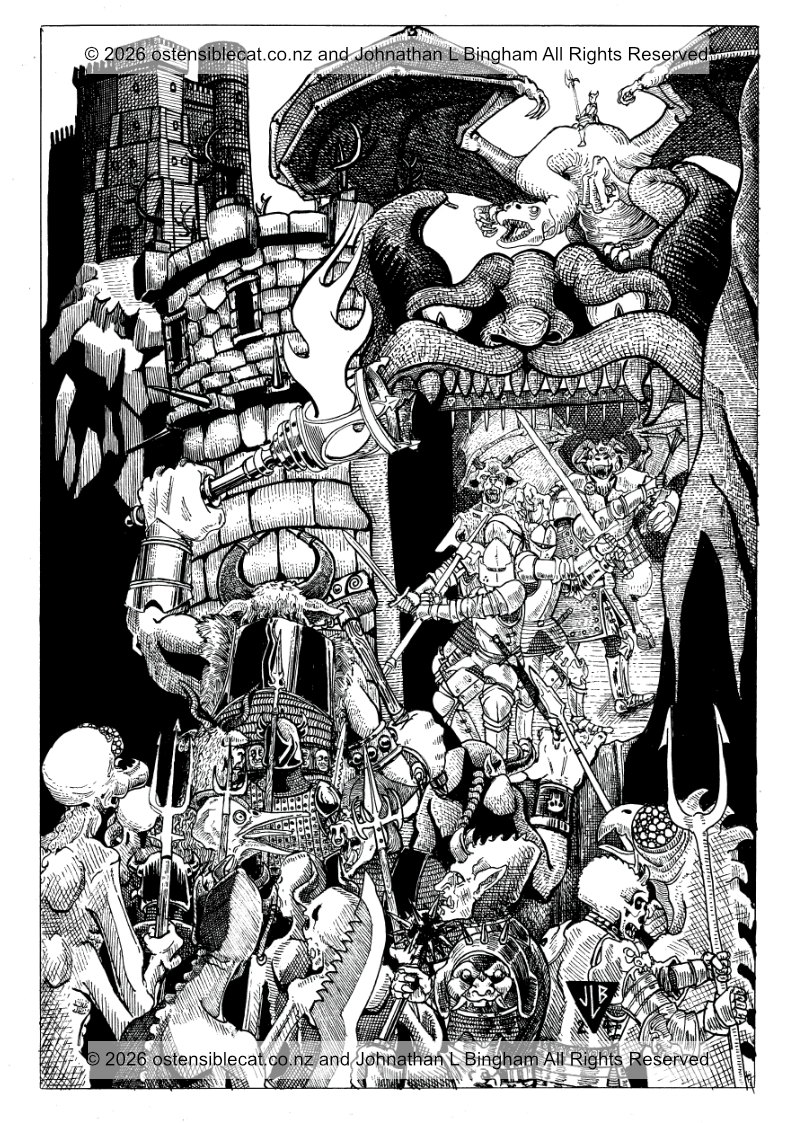
The Forest is infected, and its rot is spreading. You must aid in its collapse. There is no other option. In a bleak world where your trials are carved in pain, darkness, and blood, the world must be made whole again through collapse and rebirth. The path is brutal, and you have been chosen by Fate to see this through. You will succeed; the only questions are how long you must endure and what path you will take before the darkness is purged and a new dawn arises.

The Bleak Forest is a tabletop roleplaying game system set in a grim world of dark fantasy. You are navigating an environment beset by challenges at every turn. Yeah, you’ve heard it all before – a dark scourge and a grim world where peril awaits around every corner in a doom haunted world. Where life is short and you must manage resources and master your abilities to stave off the pain and misery around you. While those are core thematic elements, there is more to the story here. The Bleak Forest game system is intended be a game of ominous positivity: Your world is failing and you will save it by aiding in its collapse – there simply is no other choice. As the world falls into darkness, disease, and despair, it will eventually be reborn. Your part in that rebirth is inescapable, but the hell you must endure to get to the other side is defined by your actions. Drawing on mythic cycles of calamity and renewal; from the Norse Ragnarök and Fimbulvetr to the Aztec cycle of Five Suns; Beyond the Bleak Forest unfolds in the final, failing moments before cosmic rebirth. You are fated to take part in that renewal, even as hostile powers conspire to arrest the cycle and prolong the anguish of a world in peril.
The basic game engine mechanic is simple: roll over a target number, apply modifiers, and determine result. Pretty standard stuff. However, one of the driving mechanical design goals is to create a game that lent itself to being able to handle different modes of play; Co-Op, GM led, and solo. To do that, it needed to be simple enough that there would not be endless lookups and modifier balancing all the while providing structure and direction for guided play through solo or Co-Op modes, but be flexible enough to provide free form GM guided play and still feel satisfying.
The core rules comprise a common set of mechanics across Bleak Forest Engine Games. This includes:
- Character creation
- Core Mechanics
- Skills, abilities, and magic
- Basics of gameplay
These rules give you the essentials of how to play using the system and provide a framework for adapting it for use in your own settings and games. There are some areas that differ across Bleak Forest games, depending on the modular rules that are being used with character advancement being amongst them. The core rules as presented here offer a basic advancement system for use. The other modular systems for the Bleak Forest Rules are:
- Escape the Bleak Forest a solo character funnel that gamifies the character creation process. Through death and recursion, you will eventually discover your truest self and exit the Bleak Forest.
- Bleak Forest: Hail Three Wyrd Sisters is a doomed haunted world that you must prevent the rise of the Six Avatars of corruption known as the Abrikoth. Carrying over from Escape the Bleak Forest, you further refine your abilities and manifest your fate. HTWYS can be a solo, co-op, or GM-led game.
And with that, welcome to the core rules for the Bleak Forest TTRPG Game Engine. It’s a living document, so things may shift as the design grows. Have fun and happy gaming!

The Core Mechanic
Almost everything in Bleak Forest resolves the same way: roll a d20, add the relevant attribute modifier and any skill bonus, and try to meet or beat the BAM! (Basic Activity Modifier). Whenever the task requires some skill, focus, or there is an element of risk and chance of failure, then make a BAM! Check. The higher the target score, the more difficult the task.
| BAM! | Easy | Average | Difficult | Challenging | Formidable | Inconcievable |
|---|---|---|---|---|---|---|
| Target Score | 10 | 13 | 16 | 19 | 22 | 25 |
The tiers are described as follows:
- Easy (10): a relatively simple task that still requires focus, but most people can succeed 50% of the time
- Average (13): a task that requires full attention, but skilled people will succeed about half of the time
- Difficult (16): even skilled people find this demanding and only succeed about a third of the time
- Challenging (19): almost assured failure for all but the most expertly skilled
- Formidable (22): beyond the capacity of all but the most masterly skilled or magically aided
- Inconceivable (25): all but impossible – a legendary task that requires magical aid or advanced skill
A natural 1 always fails, with the worst possible outcome. A natural 20 is a critical success and always succeeds, subject to Might: against powerful creatures and threats, its effect may be reduced (see Rolling a 1 or 20 under Checks and Saves, and Might Tiers).
Saves work the same way: roll d20 + relevant attribute modifier vs. the stated BAM! to avoid something bad.

Succeed with Style
If you roll is +6 over the BAM! Target, you succeed with style. This benefits in the following ways:
- Searches find exactly what you are looking for
- Attacks do maximum damage
- Arcane effects achieve maximum effect (includes Duration, damage, Range, etc.)
- Foraging results are successful looking for a specific called item
Checks and Saves
Use a Check when your character tries something difficult or risky, such as climbing a wall, casting a spell, or attacking.
- Activity Check: Roll a d20. Add the Attribute and Skill bonuses that fit the task. If the total meets or beats the BAM! target number, you succeed.
- Opposed Check: Use this when characters compete directly. Each character rolls a d20 and adds the right bonuses. Each must meet their own BAM! target. Of those who succeed, the highest total wins. Different characters may have different BAM! targets if one has an advantage or disadvantage.
Rolling a 1 or 20 on a check: A natural 1 is always a fumble. A natural 20 is usually a critical success, but very powerful creatures can reduce its effect. Against Might 5–7, an attack still hits and the creature keeps its automatic bonus damage. Against Might 8+, the attack hits but deals only half damage. See Might Tiers for full details.
Saves: Make a save when your character tries to avoid or resist something harmful, such as poison, a spell, or extreme hardship. Roll a d20 and add the relevant Attribute modifier. If the total meets or beats the BAM! target, you succeed. A save is Easy (10) unless the rule gives a different BAM!.
Rolling a 1 or 20 on a save: A natural 1 is always a fumble. Against a normal threat with Might 0, a natural 20 always succeeds. Against more serious threats, a natural 20 may have a reduced effect. See Might Tiers and Effects for details.
Advantage and Disadvantage
Advantage makes a roll easier. Disadvantage makes it harder. Minor Advantage or Disadvantage adds or subtracts 1 from the roll. Stronger effects move the BAM! target:
- Moderate moves it 1 step (3 points),
- Major moves it 2 steps (6 points),
- Extreme moves it 3 steps (9 points).
| Tier | With Advantage | With Disadvantage |
|---|---|---|
| Minor | Add 1 to the roll | Subtract 1 from the roll |
| Moderate | Move BAM! 1 step easier | Move BAM! 1 step harder |
| Major | Move BAM! 2 steps easier | Move BAM! 2 steps harder |
| Extreme | Move BAM! 3 steps easier | Move BAM! 3 steps harder |
Stacking Advantages and Disadvantages
When you encounter multiple advantages or disadvantages of the same type in a single situation, these modifiers DO NOT accumulate. Instead, only the highest single advantage or disadvantage applies for that situation. For example, if both a Moderate and a Major advantage are present for cover, only the Major advantage is used to determine the outcome.
- When different advantages or disadvantages apply, then they stack. For instance, if you have a Moderate disadvantage to attack for cover and a Major disadvantage due to being blinded, your effective disadvantage to attack your target is Extreme Disadvantage.
- Advantages and disadvantages counterbalance each other. If a situation presents both an advantage and a disadvantage, they offset accordingly. For instance, if you have a Major advantage but also face a Moderate disadvantage, the net result is a Moderate advantage.
- Advantage or Disadvantage cannot be higher than Inconceivable (25) or lower than Easy (10). Sometimes, rather than directly applying an advantage or disadvantage to yourself; the situation may call for applying an advantage or disadvantage to your opponent.