
Bleak Forest
Action, Combat, Encounters, & Mishaps
© Johnathan L. Bingham & Ostensible Cat Design
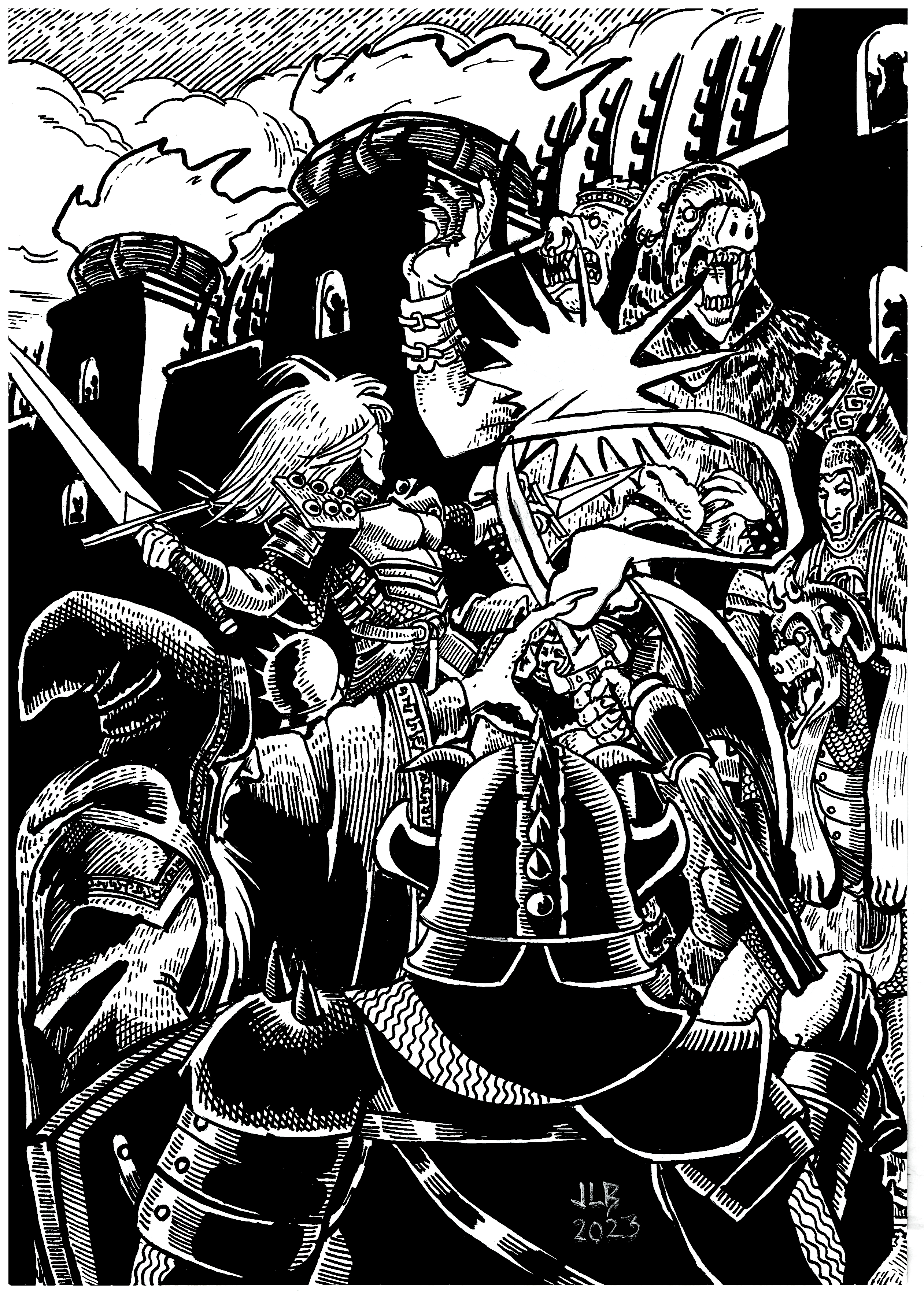
Action Economy and the Combat Round
When Combat begins, resolve play in 6-second rounds. Before the first round, confirm surprise and roll initiative. On your turn, you may take one Move action and one Standard action. A Move action covers movement up to your applicable combat rate. A Standard action covers making an attack, casting a spell or psionic power, using a skill, consuming or applying an item, or another significant activity. You may also take one Reaction per round in response to a valid trigger. A Reaction is expended when used and refreshes at the start of your next turn.
Additional attacks (via Multiple Attacks, Quick Shot, or Dual Wielding) are taken as part of the same Standard action. Each successive attack in a round is made at one BAM! step higher than the previous (the first attack uses the target’s normal BAM!; a second uses one step harder; a third two steps harder; and so on). You may never lower the BAM! of a successive attack below the BAM! of the first attack in that round. The maximum number of attack attempts from all sources combined (Multiple Attacks, Quick Shot, Dual Wielding, and special abilities) is four per round.
Actions and Diminishing Returns
A turn can be tactical (a 6-second round in an encounter) or strategic (a Watch of travel, exploration or other activity).
- Tactical turn: you get one Move action, one Standard action and one Reaction (see Action Economy).
- Strategic turn: you get one action.
You can push yourself to take more actions than that, but each extra one builds up strain as Mishap dice. Each further action becomes harder, and any failure becomes more severe. This is called Diminishing Returns.
| Extra action | Penalty | Mishap dice gained |
|---|---|---|
| 1st extra (2nd action) | Moderate Disadvantage | +1 |
| 2nd extra (3rd action) | Major Disadvantage | +2 |
| 3rd extra (4th action) | Extreme Disadvantage | +3 |
Four actions per turn is the maximum from all sources combined. Additional attacks within one Standard action follow the Multiple Attacks steps instead of this table. For how Mishap dice are held, rolled and cleared, see Mishaps and Misfires.
Mishaps and Misfires
Mishap dice build up when you push yourself or when an action goes wrong. You gain them from Diminishing Returns and from some Conditions and effects. They stay with you until cleared: a Recovery (1 Tick) clears 1 Mishap die, and a Short or Full Rest clears all of them.
When to roll. Roll on a Mishap table when any of the following happens:
- Natural 1 on a Corpus or Anima skill check: roll on the Skill Mishap table.
- Any failed Spiritus skill check (Conjuration, Mysticism or Occultism): roll on the Magical Misfire table. Exception: a failed Healing check rolls only on a natural 1.
- A failed skill check after your first action in a tactical or strategic turn: roll on the Skill Mishap table, unless the check was a Spiritus check, which uses the Magical Misfire table instead.
- Taking a second alchemical item before the first expires: roll on the Magical Misfire table.
How to roll. Roll 1d6, plus 1d6 for each Mishap die you hold. Sum the dice and read the result on the table. A natural 1 on the triggering check adds 1 more die. Never roll more than 3 dice. The more dice you roll, the more severe the likely result.
Magical Misfire
Magic is a fickle thing, even for those trained in the arts. It has unforeseen consequences, and those exposed to it for long often bear its mark.
| Roll | Misfire |
|---|---|
| 1–3 | No adverse effect |
| 4 | Incur a Minor Condition. Roll 1d6: 1–2 Corpus, 3–4 Anima, 5–6 Spiritus |
| 5 | Lose 1d3 Vitality |
| 6 | Add 1 Fatigue to your inventory for the next Watch |
| 7 | No adverse effect |
| 8–9 | Incur a Moderate Condition. Roll 1d6: 1–2 Corpus, 3–4 Anima, 5–6 Spiritus |
| 10 | Lose 1d6 Vitality |
| 11–12 | Add 2 Fatigue to your inventory. If this exceeds your Fatigue Ceiling, you are Immobile and must make a Corpus save every hour or lose 1 Corpus, until you eat, drink and complete a Short Rest (see Fatigue in Character Rules) |
| 13 | Lose 2d6 Vitality |
| 14 | Incur a Severe Condition. Roll 1d6: 1–2 Corpus, 3–4 Anima, 5–6 Spiritus |
| 15 | Add 3 Fatigue to your inventory. If this exceeds your Fatigue Ceiling, apply the 11–12 Immobile effect |
| 16–18 | Add 1d6 to your Corruption Pool (maximum 4d6), then roll the whole pool and consult the Corruption table |
Corruption
Corruption is the mark left by persistent arcane use. Magic is not safe and the Bleak Forest is not forgiving of those who use it without cost. Each time the Magical Misfire table sends you here, something is permanently added to the weight you carry. It compounds. It does not rest.
The Corruption Pool
Each character has a Corruption Pool, beginning at zero dice. The pool works exactly like the Danger Die: it is a pool of d6s that grows with exposure, and the more dice you roll, the worse the probable outcome.
Every time a Magical Misfire result directs you to roll Corruption:
- Add 1d6 to your Corruption Pool permanently. The pool never clears from rest, Short Rest, or Full Rest.
- Roll all dice in your Corruption Pool and sum the result.
- Consult the Corruption table for the sum. Apply the effect immediately.
- Maximum pool size is 4d6. If your pool is already at 4d6, do not add another die — roll 4d6 and apply the result.
| Pool | Reachable range |
|---|---|
| 1d6 | 1–6 — minor symptoms only |
| 2d6 | 2–12 — lasting marks become likely |
| 3d6 | 3–18 — permanent damage likely |
| 4d6 | 4–24 — severe and extreme results reachable |
Corruption Table
Roll your Corruption Pool (all dice, sum all results) and read the sum below. Sub-effects that require a d6 roll use a single die. All other checks and saves use d20 as normal.
| Sum | Effect |
|---|---|
| 1 | Afterglow. The corruption passes through without catching. All Spiritus checks at Moderate Disadvantage for 1 Watch; no lasting mark. Only possible at 1d6 pool — a caster’s one near miss. |
| 2–4 | Symptomatic. Roll 1d6 to determine which symptom manifests: 1–2 hand tremor (ranged attacks and fine tasks at Moderate Disadvantage until Full Rest); 3–4 shadow decouples (silhouette moves wrongly for 1d6 Watches; Hostile creatures gain +1 to first initiative roll against you); 5–6 void-echo voice (social checks using Guile or Wiles at Major Disadvantage for 1d6 Watches as creatures instinctively recoil). |
| 5–7 | The Forest notices. The Danger Die in your current hex increases by 1 until you leave it. Additionally, a nosebleed begins: lose 1 Vitality now, and for 1d6 rounds all casting costs +1 Vitality while the bleed continues. |
| 8–10 | Permanent mark. A lasting blemish forms — roll 1d6: 1–2 a lock of hair turns white permanently; 3–4 a cold spot forms on your skin that never warms; 5–6 one eye briefly flicks silver in certain light. The mark is mechanically inert, but the Crone’s next gift to you is a Scar rather than a Knot. |
| 11–13 | Something has changed. Roll 1d6: 1–3 haunted sleep — after every Full Rest, make a Spiritus save Average 13 or begin the next Watch with the Confounded condition; 4–6 fumble range expands permanently — a natural 1 or 2 on any Arcane skill check now counts as a fumble and adds one additional Mishap die. |
| 14–16 | Attribute drain. One Attribute is permanently reduced by 1 (roll 1d6: 1–2 Corpus, 3–4 Anima, 5–6 Spiritus). Only a Major Challenge success or 3rd Order Healing Arts can restore it. |
| 17–19 | Branded. A visible arcane sigil scorches permanently into your skin. Demonic and Fae creatures recognise you on sight; their starting disposition toward you shifts one step worse. Additionally, one such entity is drawn immediately: roll on the Rare Encounter table — it arrives within 1d6 Watches, Hostile, and it knows the size of your Corruption Pool. |
| 20–21 | The claim is laid. A named entity has fixed its attention on you permanently. It appears once per Recursion at a moment you do not choose, always Hostile, and cannot be permanently destroyed — only delayed. Additionally, your maximum Vitality is permanently reduced by 1d6. 3rd Order Healing can restore the Vitality reduction, once per Recursion. |
| 22–23 | You belong to it now. The Danger Die in every hex you enter is permanently +1 — the Forest has marked you as something that is no longer entirely passing through. Additionally, arcane addiction takes hold: you must cast at least one spell per Watch or gain 1 Fatigue that cannot be cleared by rest — only by casting. |
| 24 | Catastrophe. Roll the Corruption Pool twice and apply both results. If this result appears in either roll, apply it once only and treat the second instance as a 17–19. Possible only at maximum pool (4d6). |
Reducing the Pool
The Corruption Pool never clears fully. Once a die is added, it is part of you. Three things can remove a die from the pool — the pool can never drop below 1d6 once the first die has been added:
- Major Challenge success: remove 1d6 from the pool. A spiritual reckoning is one of the few forces in the Bleak Forest that can pull something back from the arcane.
- 3rd Order Healing Arts (Restoration): remove 1d6 from the pool. This can only be applied once per Recursion.
- Recursion (death): remove 1d6 from the pool on entering the new life. The body resets; the arcane debt does not fully. A pool of 4d6 enters the next Recursion at 3d6.
The Corruption Pool carries forward into Beyond the Bleak Forest: Hail Three Wyrd Sisters. A caster who exits the forest at 3d6 does not arrive in the world beyond clean. What the forest marked, the road inherits.
Skill Mishap
Skills can backfire under pressure. Roll on the Skill Mishap table when you roll a natural 1 on a Corpus or Anima check, or fail a non-Spiritus skill check after your first action. Roll as described under Mishaps and Misfires.
| Die Roll | Mishap |
|---|---|
| 1-4 | No Adverse Effects |
| 5-6 | Any skill checks for the failed skill are at a Moderate Disadvantage for the next Hour |
| 7 | No Adverse Effects |
| 8-9 | Any skill checks for the failed skill are at a Major Disadvantage for the next Watch |
| 10-12 | You are fatigued. Add 1 fatigue to your inventory |
| 13-14 | Any skill checks for the failed skill are at an Extreme Disadvantage for the next 2 Watches |
| 15-18 | You are fatigued. Add 2 fatigue to your inventory |
Encounter Procedure Reference
Use this reference when a Danger or Dread result, Special Event, Omen, scenario, or another rule introduces an immediate encounter. If the encounter type is not already specified, roll on the appropriate encounter table. Establish approach distance and visibility, determine surprise and disposition, choose an approach, and roll initiative only if action order becomes important. Resolve the encounter through social action, stealth, flight, pursuit, combat, submission, or its specific procedure, then complete Encounter Aftermath and Return.
- Roll on the Danger Die table
- If an Encounter is indicated:
- check if you have surprise
- roll on the appropriate Encounter table
- check for target’s Disposition
- check for initiative (1d6 + Anima modifier; you win ties)
- choose action: Combat, Parley, Hide, Flee, Ruse, or Submit
- begin actions
- If a Special is indicated, roll on the Special Table
| Action | When Available | Resolution |
|---|---|---|
| Combat | Always | Transition to Tactical Battle Map. See Combat in Core Rules. |
| Parley | Not if Hostile/Inimical | Guile check to shift disposition one step. |
| Hide | Requires cover | Anima check opposed by creature Anima (or Average 13). |
| Flee | Always | Make an Anima save (Average 13) to break contact; on a failure, each engaged enemy may make one free attack before you move. If an opponent follows, resolve the chase using the Pursuit and Evasion rules in the Travel chapter. |
| Ruse | Not if Hostile | Opposed Anima check. Win: bribe/deception/theft succeeds. Fail: Hostile + initiative. Natural 1: enemy gains surprise. |
| Submit | Always | Anima check Difficult (16). Success: forfeit loot, pass through. Failure: hostilities continue. |
Encounter Actions
When characters encounter others, be it monsters or NPCs, there are a few courses of action available
- Notice: Make an opposed Anima check for each party. The higher score gains surprise and acts first
- Initiative: Roll d6 + Anima modifier; highest total acts first (ties: you go first)
- Parley: Attempt to communicate with the encountered party for the purpose of trade, move peacefully through the area, or convince the party to join you
- Hide: Only possible if cover is available. Attempt to use stealth/Anima check to move through the area undetected and avoid conflict
- Flee: Attempt to break contact and avoid hostilities. Resolve all flight and pursuit using Pursuit and Evasion in the Travel chapter. Apply the current distance gap, mode of movement, terrain, and weather modifiers.
- Ruse: Attempt to bribe or steal from the other party. Failure results in opponent’s disposition immediately becoming hostile.
- Combat: Hostile action ensues
- Submit: Attempt to appease the other party and avoid hostilities. Make an Anima check (Difficult 16). On a success, forfeit all loot and pass through. On a failure, hostilities continue. The other party may also surrender to avoid a fight, letting you pass, often at the cost of treasure or equipment.
Surprise
Make an opposed Anima check for each party. The higher score gains surprise and acts first.
Initiative
Simple: Roll 1d6 and add your Anima modifier. The higher total acts first. On a tie, you act first. This uses the same rule as Combat Initiative. For a dynamic pitched battle, optionally re-roll at the start of each round.
Complex: Optional (tactical): re-roll Initiative each round. Each party rolls d20 + Anima modifier; highest acts first that round. Ties go to you.
Parley
When you meet a creature or NPC and don't know their attitude, roll two six-sided dice (2d6): 2–3 Hostile; 4–6 Wary; 7–9 Curious; 10–11 Friendly; 12 Helpful. Check the table below:
| Roll (2d6) | 2-3 | 4-6 | 7-9 | 10-11 | 12 |
|---|---|---|---|---|---|
| Reaction | Hostile | Wary | Curious | Friendly | Helpful |
- Hostile creatures will attack if they pass a Morale save or try to hinder the players if they fail.
- Wary creatures will deceive or hinder you if they pass a Morale check, or avoid you if they fail.
- Curious creatures will be Wary or Friendly depending on your approach to them. Determine your intent (friendly, neutral, or hostile).
Friendly approach: make a Guile check (d20 + Anima modifier + Guile rank) against Average (13). On a success, roll 1d6: 1–4 the creatures are Friendly, 5–6 they are Helpful. On a failure, they are Wary.
Neutral approach: roll 1d6: 1–3 the creatures are Wary, 4–6 they are Friendly.
Aggressive approach: roll 1d6: 1–4 the creatures are Wary, 5–6 they are Hostile.
- Friendly creatures are kindly disposed and will help if it costs them little: sharing information, answering questions and giving directions. They won’t endanger themselves for you, but may offer cover if it doesn’t put them at immediate risk.
- Helpful creatures give whatever aid they can, even at some cost to themselves. They may offer food or healing, lead you to the nearest safe spot, or shield you from Hostile pursuit. If suitably enticed, there is a 1 in 6 chance they will travel with you.
In addition, there are two other reaction categories that are not normally able to be altered except by exceptional skill or magical means:
- Devoted creatures are completely dedicated to the target of their devotion. They will go to great lengths to aid their ally, even risking life and limb to do so.
- Inimical creatures are completely incensed and/or unable to be reasoned with. Creatures with this disposition are always hostile and will seek to attack. Usually these are creatures of an alien/demonic/undead origin and/or lack any means of reasoning. Creatures in this category will attack until incapacitated, subdued, or killed. Only through specialized skill or magic, can this reaction category be altered.
Encounter Behaviour Table by Demeanour (d20)
Introduction:
This table provides solo players and GMs with a quick way to randomly
determine encounter behaviour based on demeanour. Roll 1d20 and consult
the appropriate row.
| Demeanour | 1-2 | 3-4 | 5-6 | 7-8 | 9-10 | 11-12 | 13-14 | 15-16 | 17-18 | 19-20 |
|---|---|---|---|---|---|---|---|---|---|---|
| Hostile | Attacks immediately | Threatens, demands tribute | Attempts to ambush | Issues ultimatum, gives you one chance to flee | Intimidates, then attacks if resisted | Calls for reinforcements or sets a trap | Tries to capture or restrain you | Uses a special ability or environmental hazard | Taunts or insults you | Attempts to destroy your equipment or supplies |
| Wary | Keeps distance, observes | Issues a warning | Demands you state your purpose | Offers a trade, but is suspicious | Attempts to mislead or send you away | Retreats if approached, but may return | Sets up a defensive position | Tests you with a minor challenge or riddle | Watches silently, waiting for you to act | Sends a messenger or animal to spy on you |
| Curious | Approaches cautiously | Asks questions | Offers minor trade or information | Follows you at a distance | Tests your intentions with a harmless trick | Invites you to share a meal or story | Mimics your actions or speech | Offers to exchange stories or secrets | Examines your belongings with fascination | Asks to join you for a short time |
| Friendly | Greets warmly | Offers aid or supplies | Shares useful information | Invites you to join them | Asks for your help with a small task | Offers to travel together for a Watch | Sings, tells a joke, or entertains | Shares a rumour or warning about the area | Offers to introduce you to an ally | Gives you a token of friendship |
| Helpful | Heals or protects you | Gives a rare item or secret | Warns of nearby danger | Offers to guide you | Shares a rumour or prophecy | Asks nothing in return, simply helps | Offers to teach you a skill or lore | Intervenes on your behalf in a future encounter | Offers sanctuary or a safe place to rest | Sacrifices something valuable for your benefit |
How to Use:
- Determine the demeanour (Hostile, Wary, Curious, Friendly, Helpful).
- Roll 1d20 and consult the corresponding cell.
- Narrate the behaviour as the encounter’s opening move or attitude.
- Adjust for context (creature type, location, your actions).
Hide
Only possible if cover is available. Attempt to use stealth/Anima check to move through the area undetected and avoid conflict
Flee
Not every encounter is worth fighting; live to fight another day! Fleeing is resolved as discussed under the Pursuit and Evasion rules in the travel section.
Ruse
A Ruse is an attempt to bribe, deceive, or steal from an encountered party before hostilities begin. It is not available once combat has commenced. Resolve a Ruse as an opposed Anima check: both parties roll d20 and add their Anima modifier; you also add your Guile skill rank if you have it. The higher total wins. On a victory, the bribe is accepted, the deception succeeds, or the theft goes unnoticed — determine the exact outcome based on narrative logic. If the outcome feels genuinely ambiguous, roll 1d6: on a 1–3 the worse reasonable outcome occurs, on a 4–6 the better one does. On a failure, the encountered party immediately becomes Hostile and initiative is rolled; the failed Ruse costs any goodwill already established. On a critical failure (natural 1 on your roll), the enemy also gains surprise and acts first in the ensuing combat.
Combat
Once hostilities commence, combat has been enjoined. Both parties make an Initiative Check to determine who acts first: roll 1d6 and add your Anima modifier. The higher total acts first. On a tie, you act first. Initiative is fixed for the encounter unless a special ability specifies otherwise.
Morale
When an enemy is reduced to 0 Vitality it must make an Anima save (d20 + Anima modifier vs. Average (13)) or flee. In a group encounter, make an Anima save (Average 13) when:
- a group of opponents takes its first casualty
- a group suffers half their losses.
Attack
To attack, roll 1d20 against the target’s BAM! and add any relevant attribute, skill, magic, and situational modifiers, such as advantage, cover, or range. If no BAM! is listed, use Average (13).
Most encounters grow harder with your Degree of the Road. In Escape the Bleak Forest, use Average (13) with 0–1 Locked attributes and Difficult (16) with 2–3. Degree scaling begins in Hail Three Wyrd Sisters.
| Degree of the Road | Baseline creature BAM! |
|---|---|
| 1st–3rd | Average (13) |
| 4th–6th | Difficult (16) |
| 7th–9th | Challenging (19) |
Individual creatures may have a higher or lower BAM! than this baseline, as listed in their stat blocks. Advantage and Disadvantage, skills and magic can modify it further.
| BAM! | Easy | Average | Difficult | Challenging | Formidable | Inconceivable |
|---|---|---|---|---|---|---|
| Target Score | 10 | 13 | 16 | 19 | 22 | 25 |
Modifiers:
Cover
Attackers are at a Disadvantage to attack when the target has cover as follows:
- Moderate Disadvantage (shift BAM! up one step) for ¼ partial cover,
- Major Disadvantage (shift BAM! up two steps) for half cover
- Extreme Disadvantage (shift BAM! up three steps) for ¾ cover
If not otherwise specified, assume the base to attack is Average (13) and apply the Disadvantage for the cover.
Darkness
Actions that rely on visual perception, including targeting or foraging, are performed at Extreme Disadvantage (shift BAM! up three steps from current difficulty) unless supported by enhanced senses, magic, or psionics.
Dual Wielding
A Master Combat character with Adept Multiple Attacks Focus can attack with both weapons, but the off-hand attack takes Moderate Disadvantage (one step), making dual wielding viable but introducing meaningful trade-offs rather than eliminating the penalty entirely.
Multiple Attacks
Each attempted attack per round after the first is made at disadvantage as follows:
- Moderate Disadvantage (shift BAM! up one step) for the Second Attack,
- Major Disadvantage (shift BAM! up two steps) for the Third Attack
- Extreme Disadvantage (shift BAM! up three steps) for the Fourth Attack
Note: four attempts per round is the maximum attack attempts from all sources combined. This includes Dual Wielding, Multiple Attacks, Quick Shot, and any special abilities. In addition, any failed attack roll past the first in a round gives the opponent a tactical opening: they may either gain Moderate Advantage on their next attack against you, or disengage one range band without triggering a free strike. This choice is made immediately and represents the enemy capitalising on your overextension. Note on Diminishing Returns: the escalating disadvantage penalties defined here (Moderate for 2nd attack, Major for 3rd, Extreme for 4th) are the definitive penalty track for attack sequences. Mishap dice accumulate normally for other actions taken on the same turn but do not stack with or replace the Multiple Attacks penalty progression.
Two handed fighting:
When you wield any melee weapon with both hands (including one-handed weapons held in two hands), you gain +1 on damage rolls. You cannot use a shield while fighting two-handed. Two-handed weapons (battle axe, two-handed sword, spear, etc.) always benefit from this bonus as they require both hands by nature.
Rest and Recovery
Rest and recovery are a necessary part of the adventuring life. How long you rest decides how much you recover. In the Dead Forest and Bleak Forest you cannot rest without setting a guard. Elsewhere, resting without a guard raises the danger (see Danger Die › Resting without a guard).
Recovery is a short pause to gather your wits and regain some composure.
- Recover 1 Vitality per Tick (10 minutes) of undisturbed rest.
- Each Tick of Recovery clears 1 Mishap die.
Short Rest is one Watch (4 hours) of minimal, undisturbed activity.
- Recover all Vitality.
- Clear all Mishap dice.
- Clear 1 Fatigue marker.
Full Rest is two Watches (8 hours) of minimal, undisturbed activity.
- Recover all Vitality.
- Clear all Mishap dice.
- Clear all Fatigue markers.
- Heal 1 point of each damaged attribute. For example, a character who has lost both Corpus and Anima recovers 1 point of each.
- Most spell effects, harmful or helpful, end unless noted otherwise.
Recovering from Conditions depends on their severity:
- Minor Conditions end once their duration passes or healing is applied.
- Moderate Conditions drop to Minor once their duration passes or healing is applied.
- Severe Conditions drop to Moderate once their duration passes or healing is applied.
- Extreme Conditions are permanent unless magical healing is applied.